
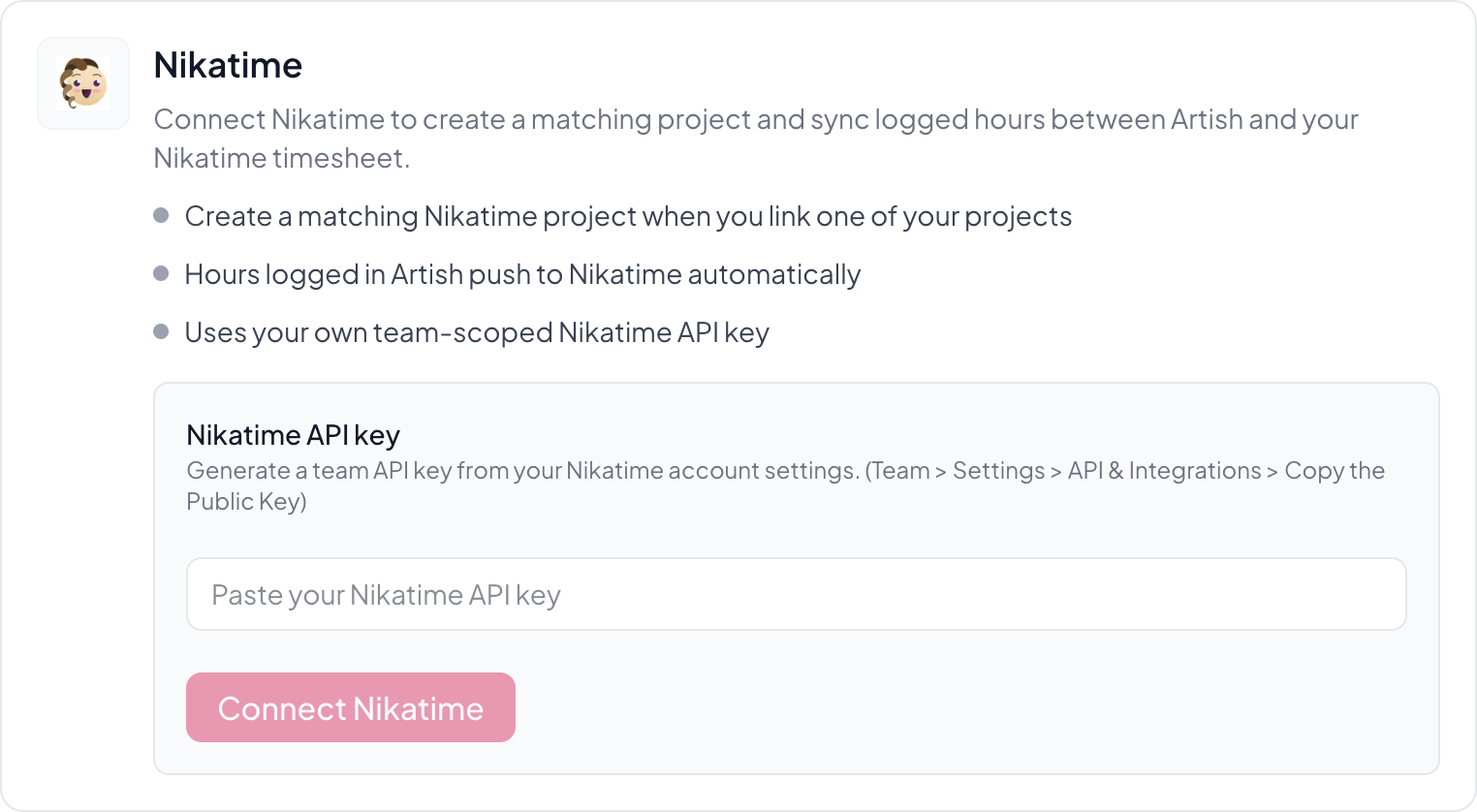
NikaTime is named after a studio manager. Some years ago Impossible, a creative company spread across four studios on three continents, had the problem anyone who has run an agency will recognise: somebody had to find out what everyone worked on, match it to a project and report it up to finance, and in Lisbon that somebody was Nika. So they built a Slack bot that asks one question at the end of every day, "What did you work on today?", and they named it after her. It has since spread to thousands of teams, which is roughly what happens to every good studio tool eventually.
As of this month, ARTISH reads from it.
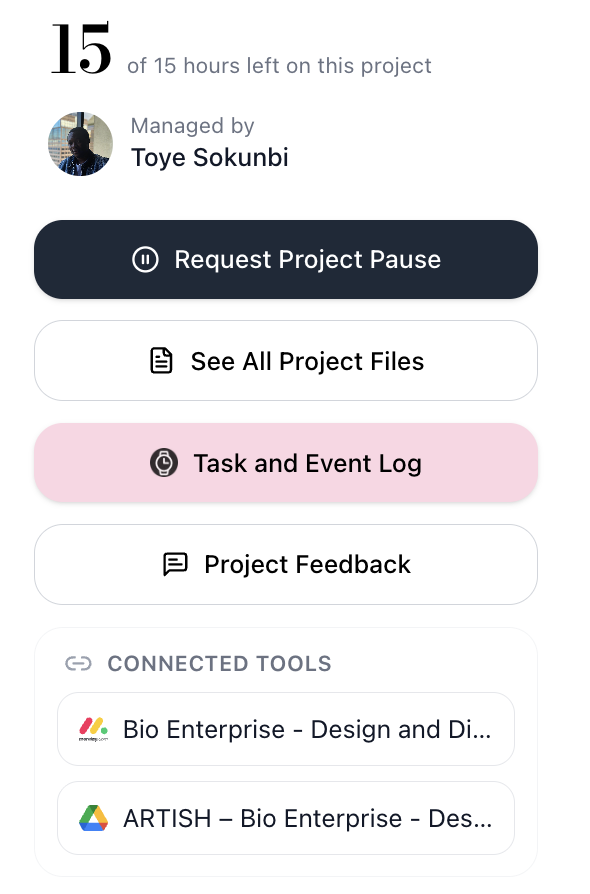
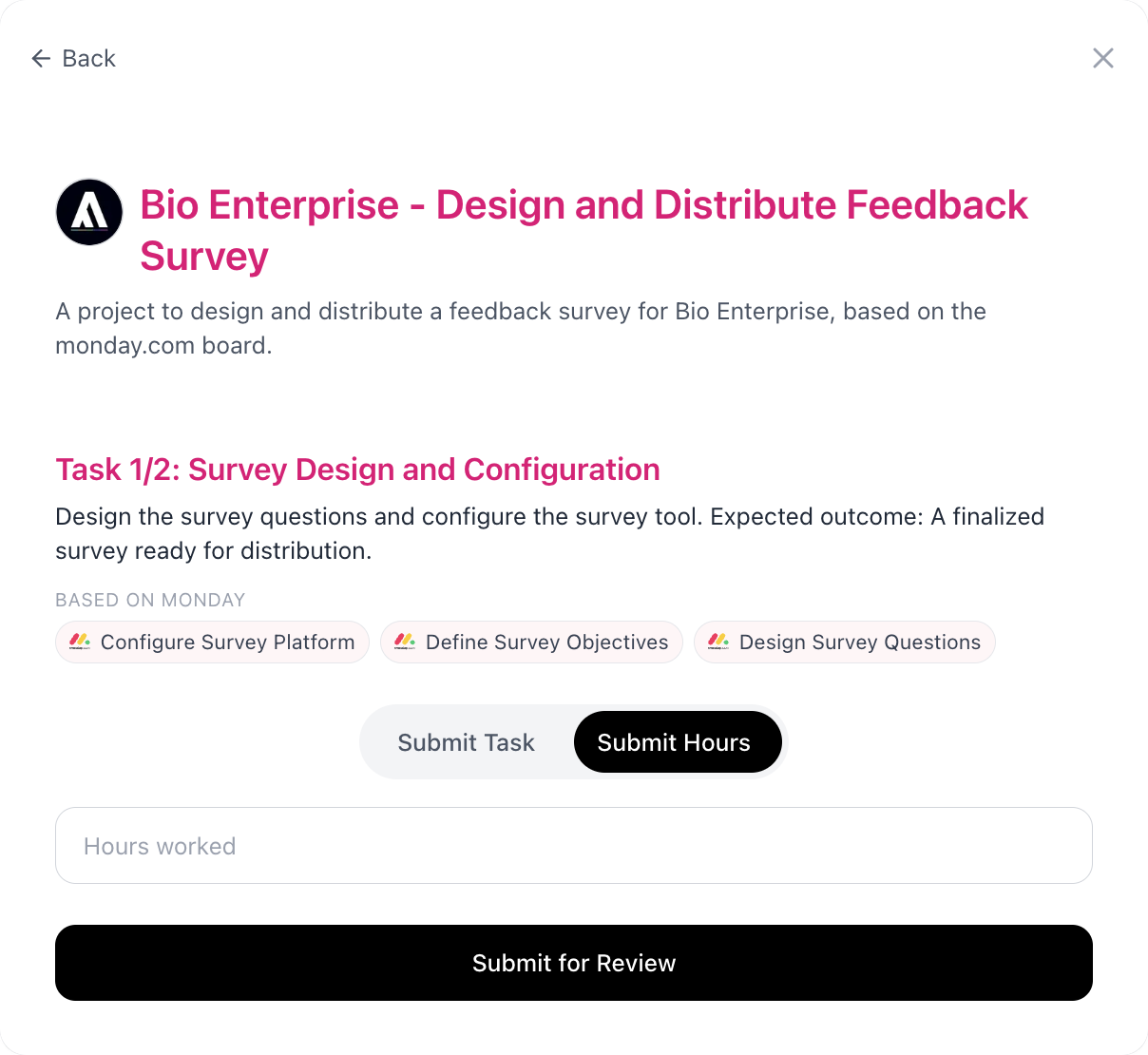
In August we said time tracking was next, so here is what shipped. Time tracking and timesheet logging now live natively inside ARTISH, at the level of the task. Open a task, switch from submitting the work to submitting your hours, log what you spent, and it goes for review the same way a deliverable does. Because it lives inside the project, logged time is tied to the milestone and invoice triggers projects already had, so the hours, the scope and the bill finally sit in the same place. None of it needs the screen, either, because all of it is reachable by prompt, and a project lead can ask how many hours are left on a job the way they'd ask a colleague.
The NikaTime integration is this month's big update, and the part I care about most, because it is the whole premise in one feature. If your team already logs time in Slack, we aren't going to ask them to stop. We pull what they've logged into the project it belongs to, where it meets the same milestones and the same invoice. Kantata, which we flagged last month, is still in development.
Agencies don't have a tooling shortage, they have too many tools, each holding one piece of the truth, and a person in the middle carrying facts between them by hand.
The case against the hour
There's a fair argument that none of this should exist.
A growing number of agency leaders have dropped timesheets altogether, and their reasoning is hard to fault. Clients don't buy hours, they buy outcomes, and an agency that bills by the hour is quietly punished for getting faster at its job. But most agencies still scope, staff, budget and invoice in hours, and they will for a while yet, because their clients' procurement departments do. The hour was never really the problem, the problem is that it lived in one tool, the task in another, the budget in a spreadsheet and the invoice in the accounting software, and every week someone expensive had to stitch the four together by hand. Hours logged against a deliverable and tied to the milestone that bills it are the same information an agency without timesheets still needs, measured in a different unit. We'd rather build for both than pretend one has already won.
What agencies told us this month
We spend much of every month in customer design sessions, and this month the pattern was blunt. There were no in-betweens.
Every agency we sat with was either frustrated with the software it already pays for, or finished with it. Some had evaluated the usual options, committed to one, built the templates, trained the team and walked away anyway, because keeping the tool updated had become the job. Others stopped waiting and built their own. Show and Tell built Blue Yeti, its own ERP, because the off-the-shelf options either didn't fit how the studio works or cost too much on a per-seat basis, and by their account the build has already paid for itself. Set Sail built Set Sail OS, which pulls client communication into one place, turns call transcripts into briefs and quotes, and checks creative work against brand guidelines before it goes out the door.
It'd be easy to read that as validation for what we're building, and it is. It's also an indictment of the software this industry has been sold. Agencies whose business is making work for clients shouldn't have to become software companies to get their own operations in order, and they keep having to, because a generation of seat-based SaaS was built for teams in general and then sold to agencies in particular.
The most useful tools in this industry keep coming from people who got tired of waiting.
WPP's week
On 22 September, Nestlé appointed WPP to design and run the content operation for all of its brands in Greater China, from Nescafé to Purina, on WPP's agentic platform, out of an operations hub in Wuxi, at more than 35,000 pieces of content a year. The next day, WPP opened Devon's Point in East London, a 34,000-square-foot facility that puts AI-powered virtual production, modular studios and post-production under one roof.
I went into this assuming Devon's Point was replacing something, that the apprentices WPP used to train by hand had been swapped for a machine room. That isn't what happened, and the truth is more interesting. WPP's Creative Technology Apprenticeship, a nine-month paid programme launched in London in 2022, is still running, with a stated goal of training at least 1,000 people by 2030. Devon's Point is its new home, and its graduates feed HEX, the roughly fifty-person AI studio WPP launched in June. WPP didn't stop training young people. It changed what it trains them to do.
The tools aren't a secret, either. When Runway made London its European headquarters in June, co-founder Anastasis Germanidis told CNBC the city "puts us close to many of our largest European customers already doing serious work with Runway, including BBC, Fremantle and WPP." And WPP has been consistent, in public at least, about where the human sits. Its chief executive, Cindy Rose, told Campaign in June that "AI will automate the ordinary and elevate the extraordinary."
The typewriter question
In 1859, Charles Baudelaire called photography "art's most mortal enemy," and twenty-five years later the US Supreme Court decided that a photograph of Oscar Wilde belonged to the man who arranged the pose, the light and the drapery, not to the camera. Painting didn't die, it moved, towards the things a camera couldn't do, and the lesson usually drawn is that AI is the same kind of instrument, a typewriter, a faster way of getting a human decision onto the page.
It's a tidy lesson, and it may even hold. But a typewriter never finished anyone's sentence, and the argument over whether a model that produces the first version of an idea is a tool or an author is still running through courts, unions and group chats, and will probably keep running for years. Not all of the resistance is about authorship, either. A good deal of it is about complicity. This month around 400 people protested in Linz against a Google data centre planned for Kronstorf in Upper Austria, where the organiser Christina Gruber said residents were never asked whether they "want to sacrifice our water resources on these huge data centres." In Batam, Indonesia, residents stormed an economic zone's offices after their water was cut while the data centres inside it kept theirs. A UN University report in April tied the mining of critical minerals for data centres and AI to polluted water in the DRC and South America's lithium triangle. People who object on those grounds aren't confused about craft, they're objecting to being made party to something they never agreed to, and a better output doesn't answer that.
The labour forecasts are just as unsettled. Dario Amodei told Axios last May that AI could wipe out half of all entry-level white-collar jobs within one to five years. This May he reached for something gentler, "If you automate 90% of the job, then everyone does the 10% of the job," and named the condition that decides which version comes true: "Companies have a choice. They can do the same thing with less resources — and that leads to things like layoffs — or they can do more with the same amount of resources. But that requires creativity."
What can actually be observed is narrower, and more useful. In June, Film Stories reported that A24 had partnered with Google DeepMind on storyboarding, weeks after Martin Scorsese did the same for a future film, and in July the analyst Audrey Schomer told The Atlantic that storyboard artists still in work are "probably being asked to use the tools themselves." The storyboard artist and the director now have closer job descriptions than at any point in the history of the form. On the operations side, the project manager, the account manager and the resource manager were three jobs largely because what each of them needed lived in three places, and once it lives in one and can be asked for in a sentence, the three start to look like one. It'd be dishonest to pretend ARTISH isn't part of that.
Whether WPP holds its line is the other open question. It's easy to keep humans at the point of judgement while AI ethics are in the news, and harder when they stop trending and a client asks why 35,000 assets still need people signing them off. Mark Read, who ran WPP until last year, told the Financial Times in April that "the big idea is still important but it's not where agencies make the money any more." That's an honest sentence about incentives, from a company midway through a restructure meant to take £500m a year out of its costs by 2028. I don't think anyone at WPP is lying about their commitment to human judgement. I think some years make it more expensive to keep than others.
The closest rhyme I can find is the internet. In March 2000 the Nasdaq peaked on the belief that everything would move online at once, and by October 2002 it had lost almost four-fifths of its value, which the people who'd refused to build a website took as vindication. Both camps were wrong. A great deal did move online, more slowly than the frontier promised and more thoroughly than the sceptics planned for, and much of the value that lasted went to people who understood a specific trade well enough to know what the new tools were for. I suspect the people at the frontier of AI and the people afraid of being left behind by it are wrong in roughly equal measure.
What doesn't depend on who's right is the knowledge: which client pays in thirty days and which one stretches it to ninety, why approvals always stall somewhere between design and development, which of the six tools a studio half-uses holds the truth. That lives in people who've done the work, and in agencies fed up enough to build their own software. It doesn't live in a foundation model, and it was never going to live in seat-based software built for everybody.
The least we can do is stop making it spend that knowledge on timesheets.