
We had a sync recently with a design partner who, halfway through what was supposed to be a conversation about file management, told us he was hoping ARTISH could be trained on his company's data. Build him something he could ask questions to. His own private assistant, fluent in his agency's history.
We had to stop and clarify: that's not what this is. It's not a slight against him.
It's the water everyone's swimming in right now. Ask a founder what they want from software in 2026 and the answer arrives pre-loaded with "AI" attached, whether or not the problem actually calls for it. And to be fair to the instinct, a chatbot on your own data is a genuinely satisfying thing to imagine. It sounds like leverage. It sounds like the future.
The trouble is, it's already the present, and it's already free. Ask ChatGPT or Claude to sit on top of your Drive and answer questions about your own files, and it will. That capability stopped being a product and became a feature of the model layer itself. If "chat with our company data" is the whole pitch, you're not competing with other vendors — you're competing with the free tier of tools your prospect already has open in another tab.
So if that's not the gap, what is?
We ran 50+ discovery interviews before writing a line of this. Not one agency told us they needed a smarter way to ask things. Every one of them described the same quieter failure: work moving between three, four, five tools, with a human in the middle whose entire job was noticing that something changed in one place and manually carrying that fact somewhere else. A status update or timesheet that should trigger an invoice. An approval that should trigger a Slack message. A milestone that should trigger a webhook into whatever the client happens to use for reporting. None of it needs judgment. Right now, it all needs a person to remember to do it.
That's not a language problem. It's a plumbing problem. And plumbing doesn't care how articulate your chatbot is, how good your prompt is, or how much context you give it.
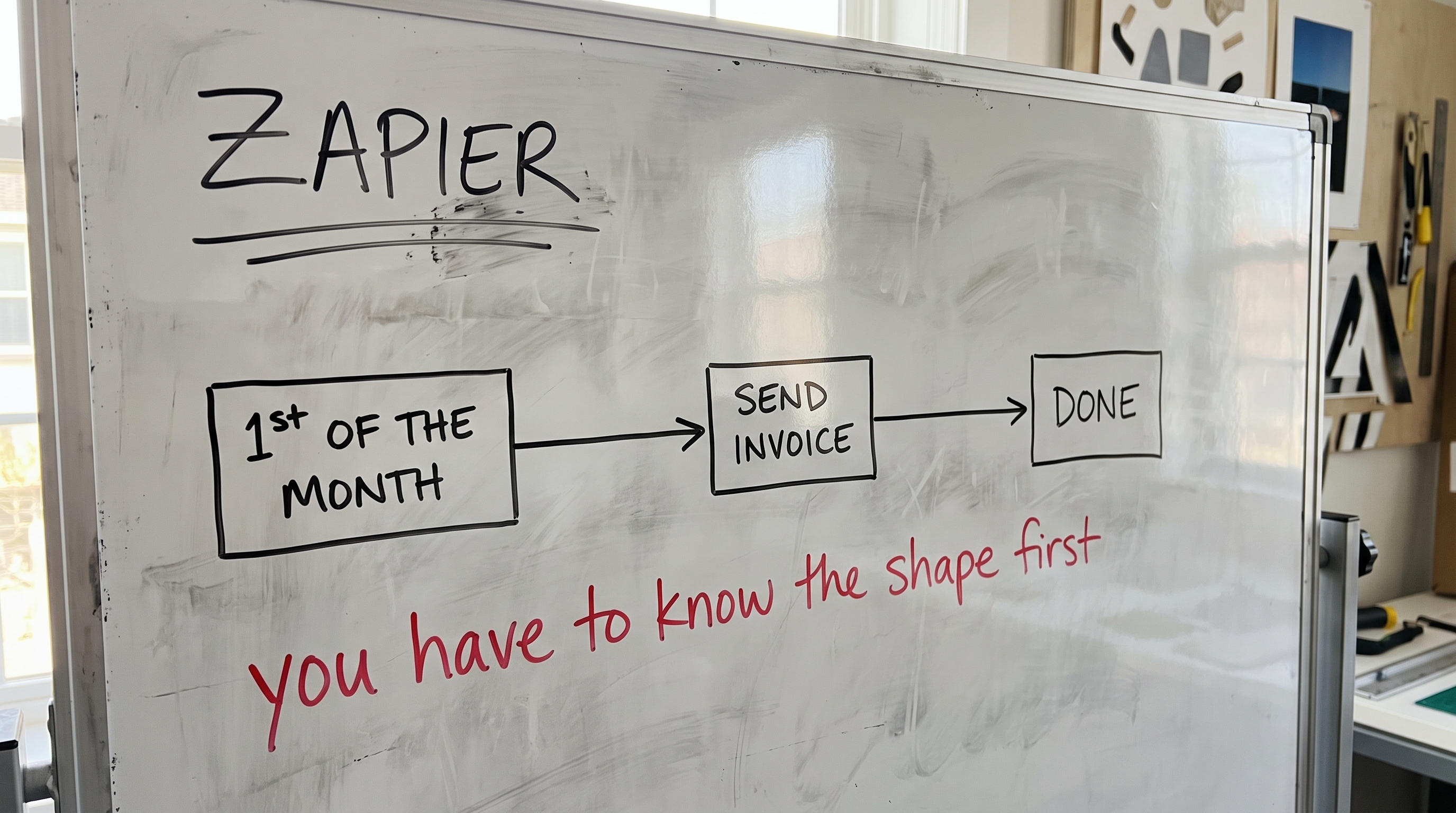
We didn't invent this category, and we're not pretending otherwise. Zapier gave the internet its first real taste of "if this, then that" over a decade ago, and it's still very good at exactly what it was built for: expected values, stable triggers, a flow that repeats the same way every time it fires. That's most of ops work. It is not most of creative work. An invoice on a fixed billing cycle is a recurrence problem. A client changing their mind mid-project, an approval that routes differently depending on who's actually free that week, a milestone that shifts because the creative direction shifted — that's not a flow you template once and let run. The trigger itself is the variable, not just the data passing through it.
That's the actual fork in the lineage. The Zapier most agencies actually touch — the linear, trigger-action Zap, not the AI layer bolted on top of it — assumes you already know the shape of the thing that's going to happen. Creative work rarely does. What we're building sits closer to the AI/MCP layer specifically because that layer can reference a trigger the way a person would — contingently, contextually, aware that "the client approved it" might mean three different things depending on which client and which project — rather than requiring the shape to be fixed in advance.
But knowing the shape isn't the same as watching for it. An MCP call, however context-aware, is still a single point-in-time action — a trigger fires, a function runs, done. It doesn't sit there noticing. It won't tell you a client's been waiting two days on an approval, or that a milestone quietly slipped without anyone flagging it. What creative teams are actually missing isn't more actions firing correctly. It's the ambient layer sitting on top of them — a live, ongoing sense of where a project actually stands, so the gap between "the system technically did the thing" and "a human noticed the thing needed doing" finally closes.
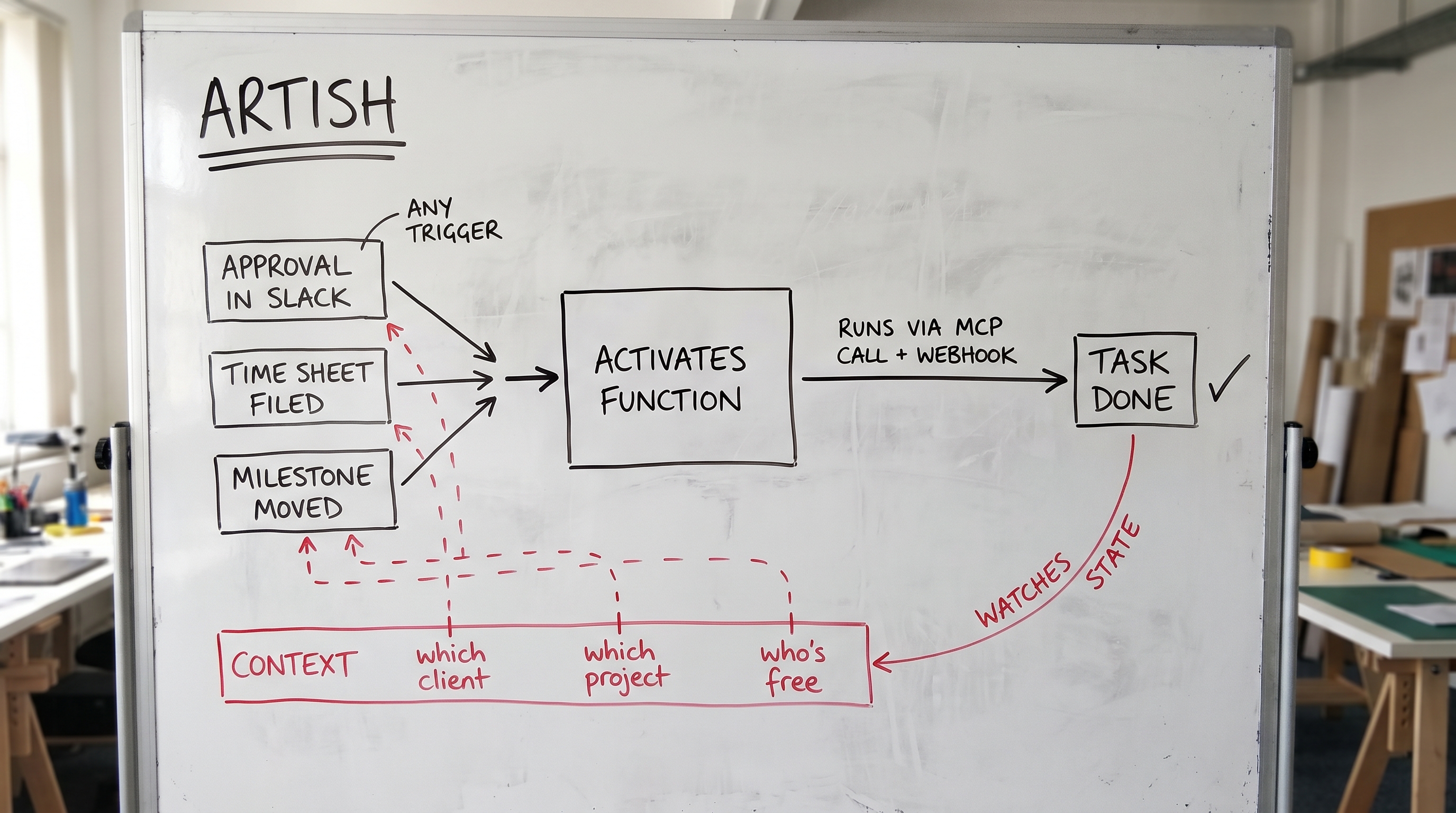
And that ambient layer has to arrive without requiring an IT hire to install it. Every automation category that's promised to "connect your tools" has quietly reintroduced the exact person it claimed to remove — someone technical enough to wire up the triggers, maintain the integrations, debug it when something silently stops firing. Most agencies don't have that person, and were never going to hire one just to make their own project software work. Software that needs a technical translator to exist isn't really no-code. It's code with a translator.
We stopped mentioning AI in our pitches a long time ago, and it wasn't a branding decision — it was a precision decision. The word invites the wrong mental model before you've even opened the deck. What we actually sell is the unglamorous part: the connective tissue between the tools an agency already uses, and the ambient awareness of a project's actual state, so a person doesn't have to be the connective tissue, or the watcher, instead.
None of this makes the chatbot (or my favourite slopaganda term, "personal AGI") instinct silly. It just isn't the thing that's actually broken. And building for the instinct instead of the breakage is how you end up with software that demos beautifully and gets used by no one three weeks later.
We'd rather be invisible than clever.